Automatic Swing Gates in the Hills District and Hawkesbury
Swing gates are the classic choice for wide Hills District frontages and rural entrances. They work best where the ground inside the gate is fairly level, and they need the right motor for the weight and width of each leaf.
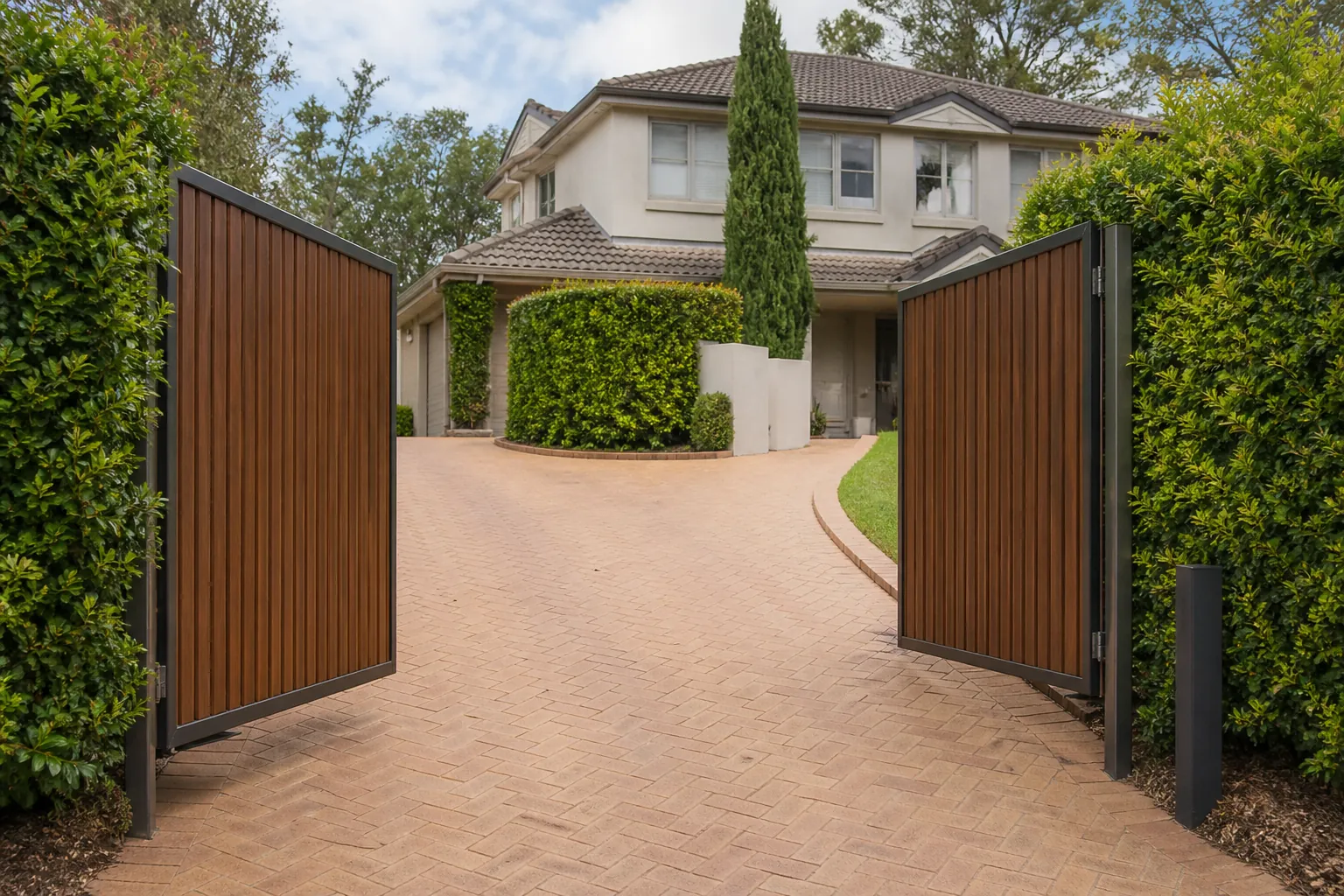
Where swing gates suit the Hills
Swing gates are the most common style on larger blocks in Castle Hill, Baulkham Hills and West Pennant Hills, and on almost every kind of rural entrance from Dural out to Wilberforce. They suit wide openings, they do not need a track across the driveway, and a pair of leaves meeting in the middle suits both a formal brick front and a post and rail paddock.
They suit less well where the driveway climbs steeply from the street. A leaf that swings into rising ground will scrape, and the motor works harder pushing a gate uphill. Many of the older Hills subdivisions sit on sloping land, so the first thing an installer checks is the level across the full arc of each leaf.
Inward opening is the rule
Under the NSW exempt development fencing rules, gates must not open outward. Even where a gate needs approval, opening into the property is the sensible default: an outward swinging gate on a footpath or road shoulder is a hazard to anyone walking or driving past. Plan for the leaves to open inward, and make sure nothing parked on the driveway sits within the swing.
Choosing a motor
There are three broad types of swing gate motor:
| Motor type | Suits | Things to know |
|---|---|---|
| Linear (ram) arm | Most residential and rural gates | Mounted on the post and leaf; needs room behind the post |
| Articulated arm | Thick brick or sandstone pillars | Folds as it opens; handles posts with little clearance |
| Underground | Formal entries where you want no visible motor | Sits in a sealed box below the hinge; drainage is critical |
The weight and width of each leaf decide the size of the motor. A tall timber-clad gate catches a lot of wind, and in the open country around Kenthurst and the Hawkesbury wind load on a solid leaf is a real factor. Installers commonly work with brands such as BFT, Nice, FAAC, Centurion and DACE, and will recommend a motor rated for the leaf they are hanging.
Underground motors look tidy, but they sit in a box that can fill with water. On heavy clay or low ground, such as parts of the Hawkesbury flats, ask how the box will drain before you commit to one.
Safety and obstacle detection
An automatic gate is a heavy moving object. The Australian safety standard covering electric drives for gates is AS/NZS 60335.2.103, and a properly set up system should stop or reverse when it meets an obstruction. Most installers add photoelectric safety beams across the opening as well. If children, dogs or horses move around the driveway, talk through where the beams go and how the closing force is set.
Power and wiring
Swing gate motors are usually low voltage, run from a control box with a transformer and backup battery. If the control box is fed from mains power, that supply is electrical installation work, and in NSW it has to be done by a licensed electrician. Where mains is a long way off, a solar kit is often simpler.
Automating an existing swing gate
If you already have a pair of swing gates that are straight, hang well and swing freely by hand, they can often be motorised. The installer will check the hinges, the posts and whether the gates still close evenly. A gate that drags or has dropped on its hinges needs fixing first, because a motor will only make the problem worse.
Request a quote and we will pass your details to a local installer who can assess your gate and frontage.
Why choose us for automatic swing gates
- Leaf arc checked against the driveway levels before anything is ordered
- Arm, articulated or underground motors matched to your posts
- Inward opening layout to keep the footpath and road clear
- Safety beams and obstacle detection set up for kids and animals
- Existing swing gates assessed for motorising where they are sound
Automatic Swing Gates: common questions
Can my existing swing gates be automated?
Often, yes, if they are straight, hang well and swing easily by hand. An installer will check the hinges and posts. Gates that drag or have sagged usually need repair or rehanging before a motor goes on.
Are underground swing gate motors a good idea?
They suit formal entries where you do not want a visible motor. The trade-off is that they sit in a box below ground, so drainage needs careful planning, particularly on clay or low-lying land.
Will a swing gate work on my sloping driveway?
It depends on how the ground rises across the arc of each leaf. A small slope can sometimes be handled by raising the hinge line or using rising hinges. On a steep driveway a sliding gate is often the better answer.
Planning a new gate or automating an old one?
Tell us about your property and we will pass your details to an independent local installer who works across the Hills and Hawkesbury.